


 The short answer
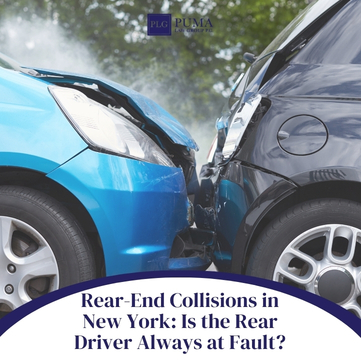
Not always, but usually. In New York, when one car hits the back of a vehicle that is stopped or slowing down, the law presumes the rear driver was negligent. You can overcome that presumption, but only if the rear driver gives a believable, non-negligent explanation for the crash.
If you were hit from behind, this rule often works in your favor. If you were the rear driver, it does not automatically mean you were to blame. Below, we explain how New York courts decide fault in rear-end collisions, when the rear driver may not be responsible, and what injured drivers and passengers should do next.
Why New York presumes the rear driver is at fault
Every driver has a duty to keep a safe distance from the vehicle ahead and to adjust that distance for speed, traffic, and road and weather conditions. There is no fixed number of feet. The question is whether the following distance was reasonable under the circumstances.
Because of that duty, when one car hits the back of another that is stopped or slowing, New York law presumes the rear driver was negligent. In plain terms, the crash itself points to the driver in back, who then has to explain why it was not their fault.
Saying the car ahead “stopped short” often is not enough, especially in heavy or stop-and-go traffic. Drivers are expected to anticipate foreseeable stops in the traffic around them and leave enough room to react.
For people hit from behind, this rule can make it easier to show the other driver is responsible for the crash.
When the rear driver may not be at fault
The presumption is strong, but it can be overcome when the rear driver has a believable, non-negligent explanation for the crash. Whether one applies depends on the specific facts and evidence. Examples include:
- A truly sudden, unexpected stop by the lead vehicle. This is hard to prove in normal or heavy traffic, where stops are expected. The driver in front also has a duty not to stop or slow down suddenly without a good reason or proper signaling.
- A sudden lane change in front of the rear driver. If a vehicle cuts into the lane and then stops or slows abruptly, leaving no time to react, the rear driver may not be at fault.
- Unexpected mechanical failure, such as brakes that fail without warning.
- Being pushed from behind. In a chain-reaction crash, a driver whose car was struck and pushed into the vehicle ahead may not be negligent at all (more on this below).
The rear driver has to support the explanation with evidence. A bare claim that the other car “stopped short” often fails, which is why evidence from the scene matters so much.
Chain-reaction crashes and shared fault
Multi-car rear-end collisions. When three or more vehicles are involved, fault can be split in different ways. A driver in the middle whose car was properly stopped, then struck from behind and pushed into the car ahead, may not be negligent. In that situation, attention generally turns to the driver at the back of the chain.
More than one driver at fault. Sometimes both drivers did something wrong, for example, a rear driver following too closely and a front driver who stopped abruptly without signaling. New York follows a comparative negligence rule: an injured person who was partly at fault can still recover damages, but their share of the blame reduces the amount.
Fault, no-fault insurance and your injury claim
New York is a no-fault state, which surprises many people after a rear-end crash. Even when the other driver is clearly at fault, no-fault coverage on your own auto policy generally pays first for economic losses such as medical bills and part of your lost wages, up to the policy limits.
No-fault benefits come with strict deadlines, so notify your insurance company in writing as soon as possible after the accident.
Fault matters for the next step. To sue the at-fault driver for pain and suffering, New York requires your injuries to meet a legal “serious injury” threshold, or your economic losses to go beyond what no-fault covers. Fractures and injuries that keep you from your normal daily activities for an extended period may qualify.
That is why rear-end cases are often about two questions at once: who caused the crash, and whether the injuries meet the legal threshold. Medical records from the start of treatment are often central to the second question.
What to do after a rear-end collision
Because fault can turn on details like traffic conditions, signaling, and following distance, the evidence you gather early can make a real difference.
- Call 911 and get medical care. Some injuries are not obvious right away. A prompt medical record also helps connect your injuries to the crash.
- Document the scene. Photograph all vehicles, their positions, damage, traffic signals, road conditions, and any skid marks.
- Get names and contact information from the other drivers and any witnesses.
- Save video. Dash cam footage and footage from nearby businesses or homes can show exactly how the crash happened. Ask about it quickly, because it may be recorded over.
- Notify your insurer in writing right away to protect your no-fault benefits.
- Be careful what you say. Stick to facts with police and insurers, and avoid guessing about speed or fault.
- Talk to a personal injury lawyer before giving a recorded statement to the other driver’s insurance company.
Watch the deadlines. New York sets strict time limits for filing an injury lawsuit, and claims involving a town, county, or other government vehicle have much shorter notice deadlines. Speaking with a lawyer early helps ensure you don’t miss any.
Frequently asked questions
If I rear-ended someone, am I automatically liable? No. New York presumes the rear driver was negligent, but you can rebut that presumption with evidence of a non-negligent explanation, such as an unexpected lane cut-off or being pushed from behind.
Can I recover if I was partly at fault? Yes. Under New York’s comparative negligence rule, your recovery is reduced by your percentage of fault but is not barred.
Who pays my medical bills after a rear-end crash in New York? Your own auto policy’s no-fault coverage generally pays first, regardless of who caused the crash, up to the policy limits.
Can I sue for pain and suffering? Only if your injury meets New York’s “serious injury” threshold or your economic losses exceed basic economic loss.
Hurt in a rear-end collision on Long Island? Talk to Puma Law Group
At Puma Law Group, P.C., you speak directly with a lawyer about your case. Your case evaluation is free, and you pay no fee unless we win.
Call 631-6INJURY or (631) 320-5556, or contact us online. Our office is at 490 Rosevale, Ronkonkoma, New York 11779, and we serve injured people across Long Island and New York City.
Attorney Advertising. Prior results do not guarantee a similar outcome. This article is for general educational purposes only and is not legal advice. Reading it does not create an attorney-client relationship.
Categories